Vision · context · results
A small device for an old problem.
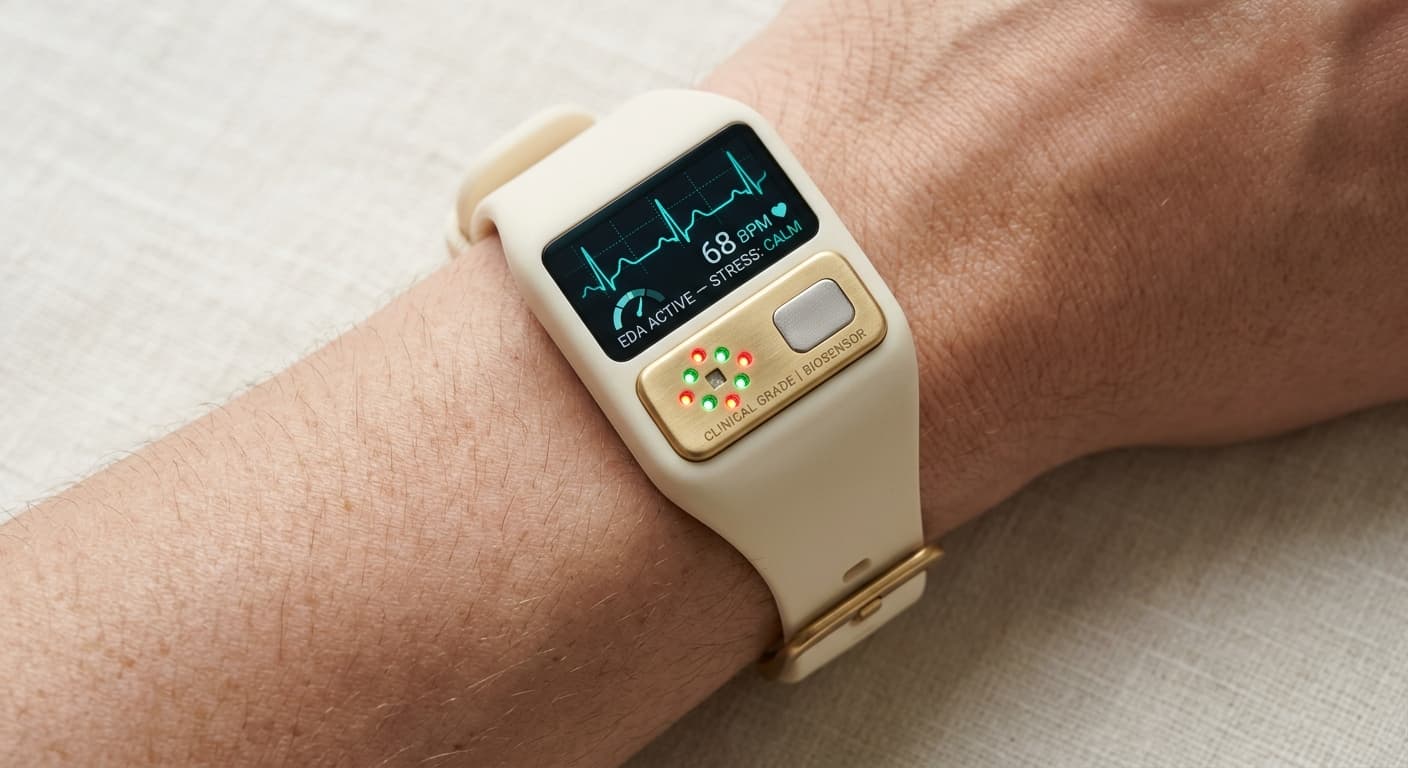
Obsessive-compulsive disorder is hourly, but therapy is weekly. Calmix turns the body into a continuous, honest narrator — and lets the science of stress work between sessions.
Why now
Why a wearable, why now
Sessions are episodic
A therapist sees a snapshot. The body lives in a stream. Wearables make the stream visible without intruding.
Self-report is fragile
When a compulsion is overwhelming, journals get skipped. Physiology cannot lie or forget.
Phones are not enough
Phones know location and steps. They cannot see the heart-rate variability of an intrusive thought.
Autonomic fingerprint
The autonomic fingerprint of OCD
The sympathetic nervous system surges seconds after an intrusive thought. The parasympathetic recovery is slower in OCD. Calmix listens to both ends of that conversation.
Cortico-striato-thalamo-cortical circuit
The neural loop implicated in OCD. Calmix does not measure it directly, but its downstream effects ripple through the body.
Sympathetic activation
Heart rate up, HRV down, sweat conductance up, peripheral temperature down. A clean burst, easy to detect.
Parasympathetic recovery
Slower recovery curves are characteristic. Calmix tracks how long it takes the body to come back to baseline.
Methodology
Signal pipeline
Acquisition
Sensors → AFE → ADC. Time-synchronized at the microcontroller.
Filtering
High-pass to remove drift, low-pass for high-frequency noise, accelerometer-based motion gating.
Feature extraction
HR, HRV (SDNN, RMSSD), tonic SCL, phasic SCRs, skin-temp trend, activity windows.
Normalisation
Each feature is z-scored against the user’s own baseline learned during calibration.
Scoring
Hybrid linear + nonlinear model returns S(t) on a 0–100 scale.
Decision
A threshold ladder selects between silence, a gentle nudge, a guided breath or an ERP/CBT cue.
Stress score · S(t)
The stress score, S(t)
A weighted linear part keeps the model interpretable. A small nonlinear correction handles the spikes. Together they fit on a microcontroller.
Hybrid model
S(t) = Σ Wᵢ · xᵢ,n(t) + b + φ( x(t) )
Normalized features per user baseline.
Adaptive per-feature weights, updated online.
Bias term tuned during calibration.
Small nonlinear correction for high-activation regimes.
Control objective
lim S(t) ≤ Scrit
Keep S(t) below a clinically meaningful critical threshold S_crit, on average, across the day.
Therapy logic
Therapy logic
Intensity is non-linear: gentle below the lower threshold, scaled in the mid-range, amplified when the score approaches the upper threshold.
Silence
Below S_low Calmix does nothing. Quiet is a feature.
Gentle nudge
Between S_low and S_high, a soft haptic and a 4-7-8 breath suggestion.
Amplified intervention
Above S_high, a guided breathing session, a grounding prompt and — if planned — an ERP/CBT cue.
Feedback
The user rates the score. The controller updates weights so tomorrow is more accurate.
Pilot signals
What the signal looks like
Pilot recordings show the expected fingerprints: clean baseline curves at rest, sharp synchronized excursions on triggered events.
Heart-rate variability
Lower RMSSD and SDNN during stress events, with a slower return to baseline.
Skin conductance
Tonic SCL ramps up during sustained anxiety; phasic SCRs cluster on intrusive thoughts.
Peripheral temperature
A gentle, minute-scale drop confirms sustained sympathetic dominance.
Breathing
PPG-derived respiration rate rises and becomes irregular; the guided breath brings it back.
Roadmap
Where Calmix is going
Clinical pilots
Move from bench validation to small ethics-approved trials with clinicians and OCD patients.
Per-user models
Replace shared weights with on-device personalized estimators, distilled from a base model.
ERP companion
Schedule, log and support Exposure-and-Response-Prevention sessions, with consented therapist export.
On-device by default
Keep raw waveforms on the wrist. Only consented features ever leave the device.